Contents
This is the first post in a series chronicling why and how I built Balances, and what I learned along the way.
The app’s raison d’être
The need to have a clear picture of my net worth has been evolving for me. In my younger years, like a lot of other young people who haven’t experienced the harsh realities of life, I basically ignored it. Then I started working, started investing, got married, moved between jobs, and progressed my career. Over the years it became increasingly important to me (and my family). The more it became important, the more it frustrated me.
I’ve been tracking my personal finances since 2011, ever since I got my hands on this thing called mutual funds. Back then I relied solely on the bank’s statements. I had two bank accounts: one for my daily spending and one at the bank I bought the mutual funds through. Those are two different banks. I didn’t want to have to log into separate apps just to sum everything up in my head, so I started taking notes. That got old pretty quickly. Even more so because every time I moved to a different company, I had to open a new bank account at another bank.
The predecessors
I then explored my options. I discovered a whole genre of apps: personal finance trackers. And I tried a bunch of them. One that I used for a long time was GnuCash. It’s open source, I could run it locally and didn’t have to be online, and I could run it on any operating system. I was ecstatic. I started tracking everything: daily spending account, savings account, mutual funds (I bought more), gold, and even what’s in my wallet. I was really into the habit of writing down everything I spent. It was fun, for a while.
GnuCash worked well because I had a simple daily routine: wake up, go to work, go to the beach (one of the perks of working in Bali), eat, sleep, then repeat. The moment I had other plans, this broke: I needed to remember every expense until I got back home and opened my laptop. Enter Firefly III.
Firefly allowed me to record my transactions from anywhere because it’s a web app. It was also fun because I got to self-host it on my own server, by myself. Engineers (if you’re reading this, you’re probably one) like the hassle.
However, recording every expense still felt like a chore. Both GnuCash and Firefly III use double-entry bookkeeping1. That’s too much work for one person. A “groceries” account that grows and grows the more I buy veggies and never gets reset doesn’t really make sense for me. That also meant a single transaction I missed threw the balance off, and I had to hunt down where it went wrong. As if my life wasn’t already full of bug-hunting chores…
I needed a way out.
Reimagining the flow
In 2016, I decided that I didn’t want detailed transactions any more. I wanted something simpler and more long-term: one number that told me whether I’m richer or poorer. So, why not just sum everything from the bank statements, once a month?
Enter Google Sheets.
I started with one workbook. Simple formulas. One graph. I exported my data from Firefly and copied it to the one workbook. It works. It’s simple. It’s liberating.
Of course, being the metric-driven engineer that I am, and bolstered by the fact that I can build any formula I like, I tuned and tuned the workbook. Then another workbook appeared, and another one. In total, my setup grew to twelve workbooks and dozens of complicated formulas. It still works, it’s still simple, it’s comprehensive and provides me a ton of metrics, and I loved the once-a-month cadence.
Why not stick with it?
Emboldened by the apparent simplicity of my workflow, and having new options to diversify our nest egg, I started expanding: buying more mutual funds, then stocks, government bonds2, and term deposits3. I already had the workbooks partitioned by the type of asset I tracked in it. But, every new thing I bought meant adding another column, and the workbooks quickly went sideways, literally.
Then, there was a problem with things that I no longer have. When I sold one of my stocks, I still had to keep the column and enter zeroes each month. Or, I could repurpose the column for another stock. That didn’t go so well.
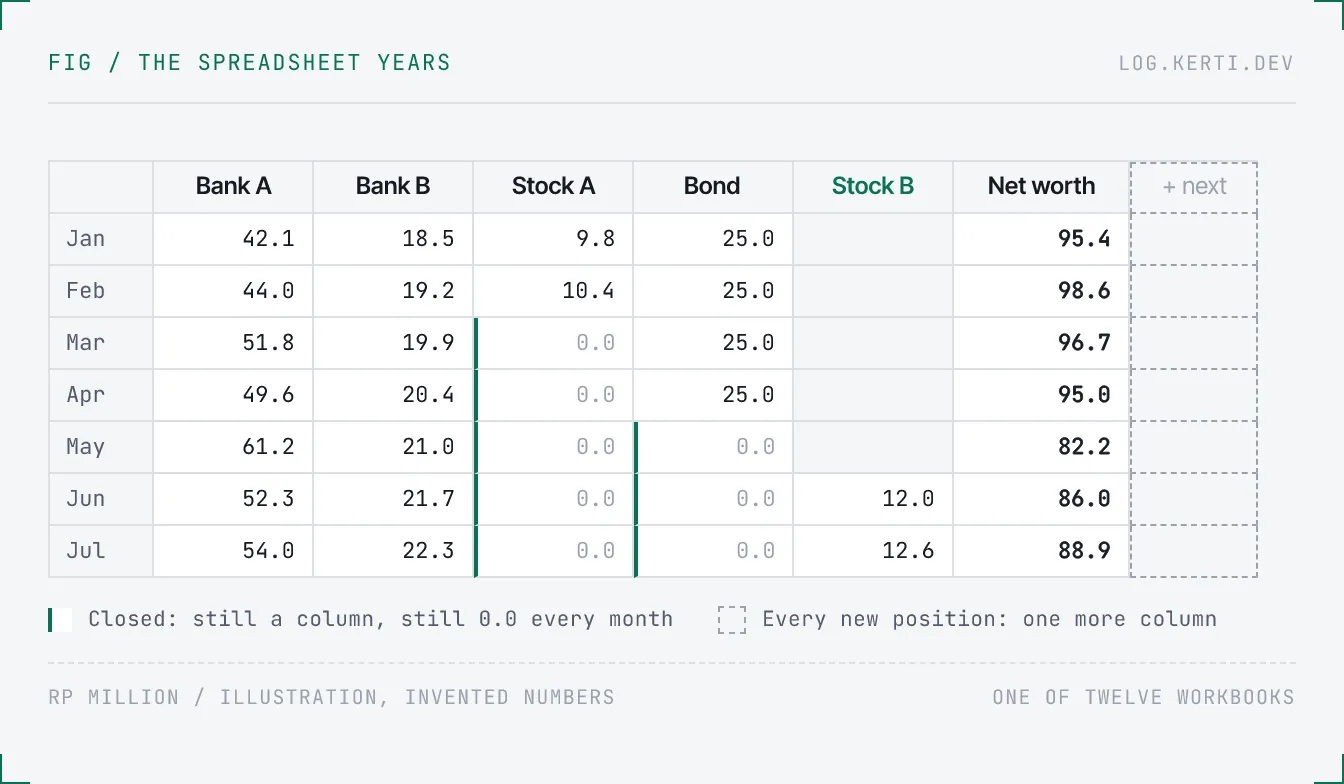
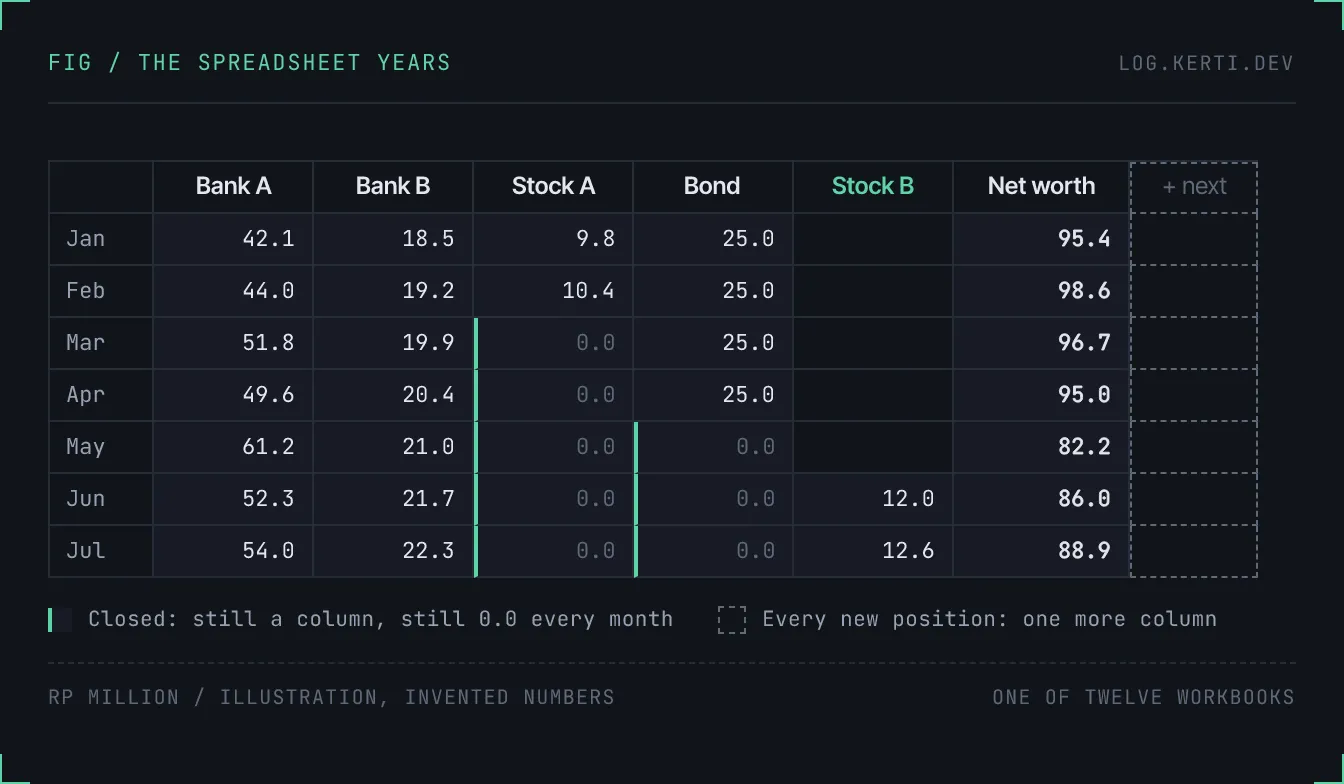
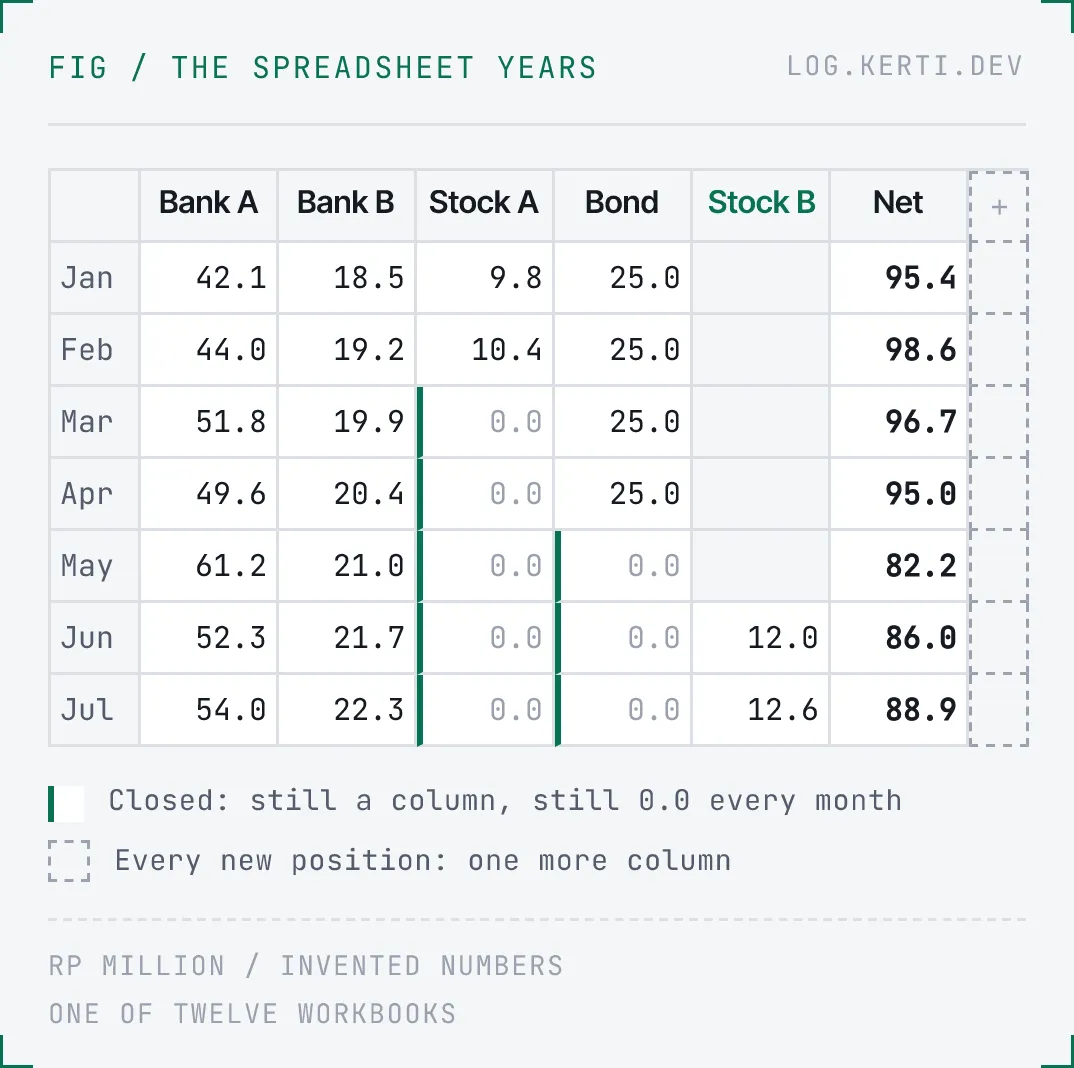
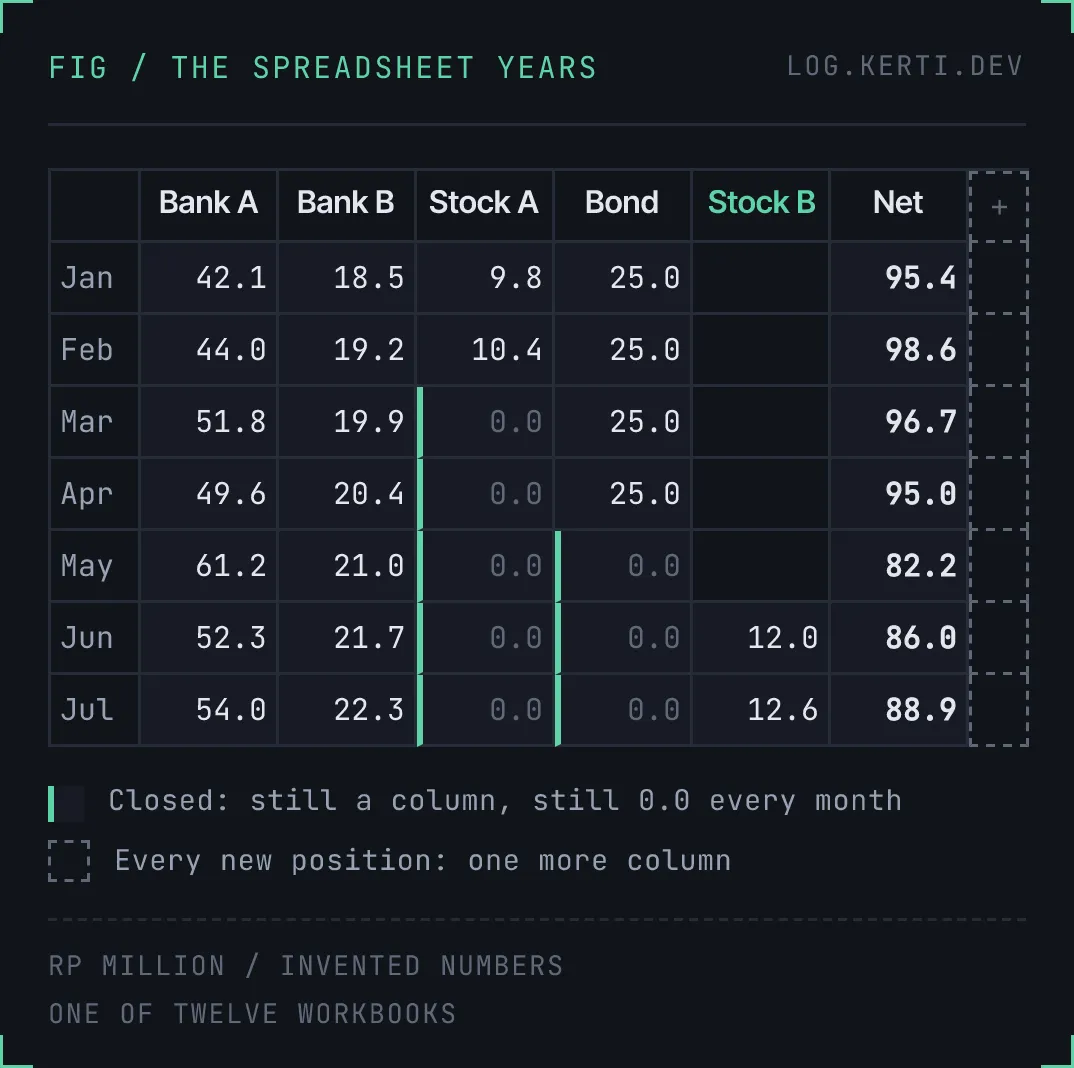
I had the cadence and the data, but the shape of the workbook became my next frustration.
Building the app
I am a software engineer. I have a real-world problem that I solve with an app (in this case, Google Sheets). I hated the way it worked, nay, the way I worked with it4. Solution: build my own app.
I started building the earlier version of Balances in mid-2020. Back then, I was working at Sorabel. The company was adjusting to COVID-19, and our working hours were cut short. I had time, and an itch to build things.
I bootstrapped the app using a pre-made backend Go app setup and a free dashboard template I got from GitHub. I coded by hand, no AI (because coding agents hadn’t entered the scene yet).
Distracted and neglected
After the closure of Sorabel, I went to work at Evermos. Working full-time again, my itch for building things was soothed. Evermos was still in its early years, and the excitement of building new things for a young company (just like I did at Sorabel) distracted me from Balances. It sat there in the corner, neglected for years.
Rekindling the spark
In the later stages of my career, when I became an Engineering Manager, the itch to get back into coding reappeared. There were a couple of bursts of coding sessions. However, the day job was already taxing my energy, so progress went at a snail’s pace.
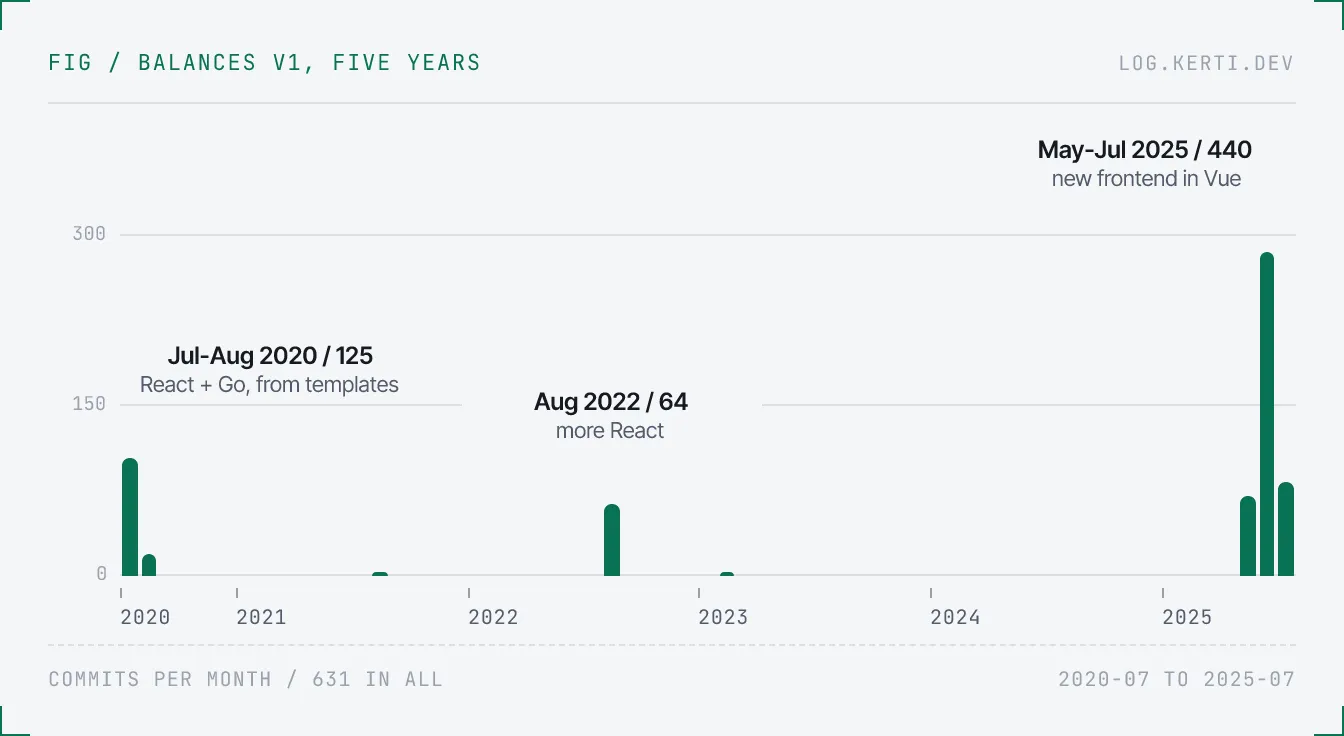
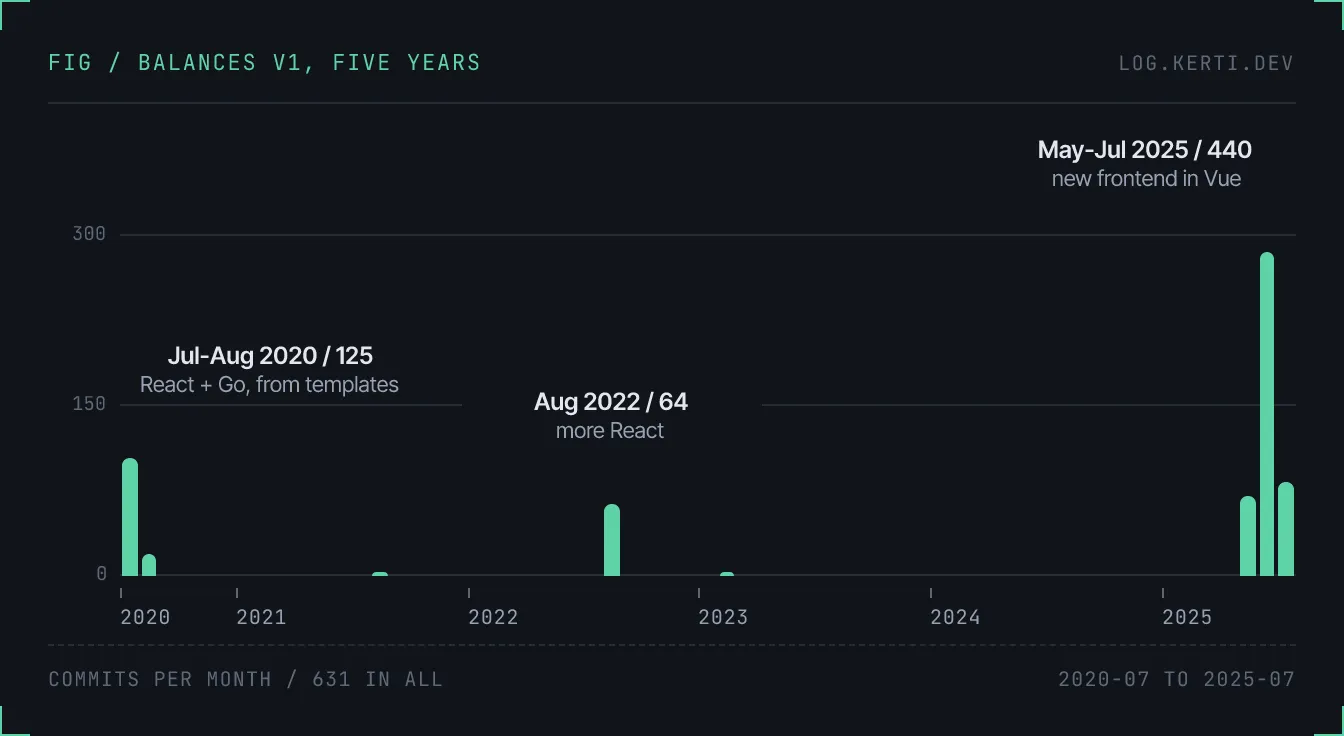
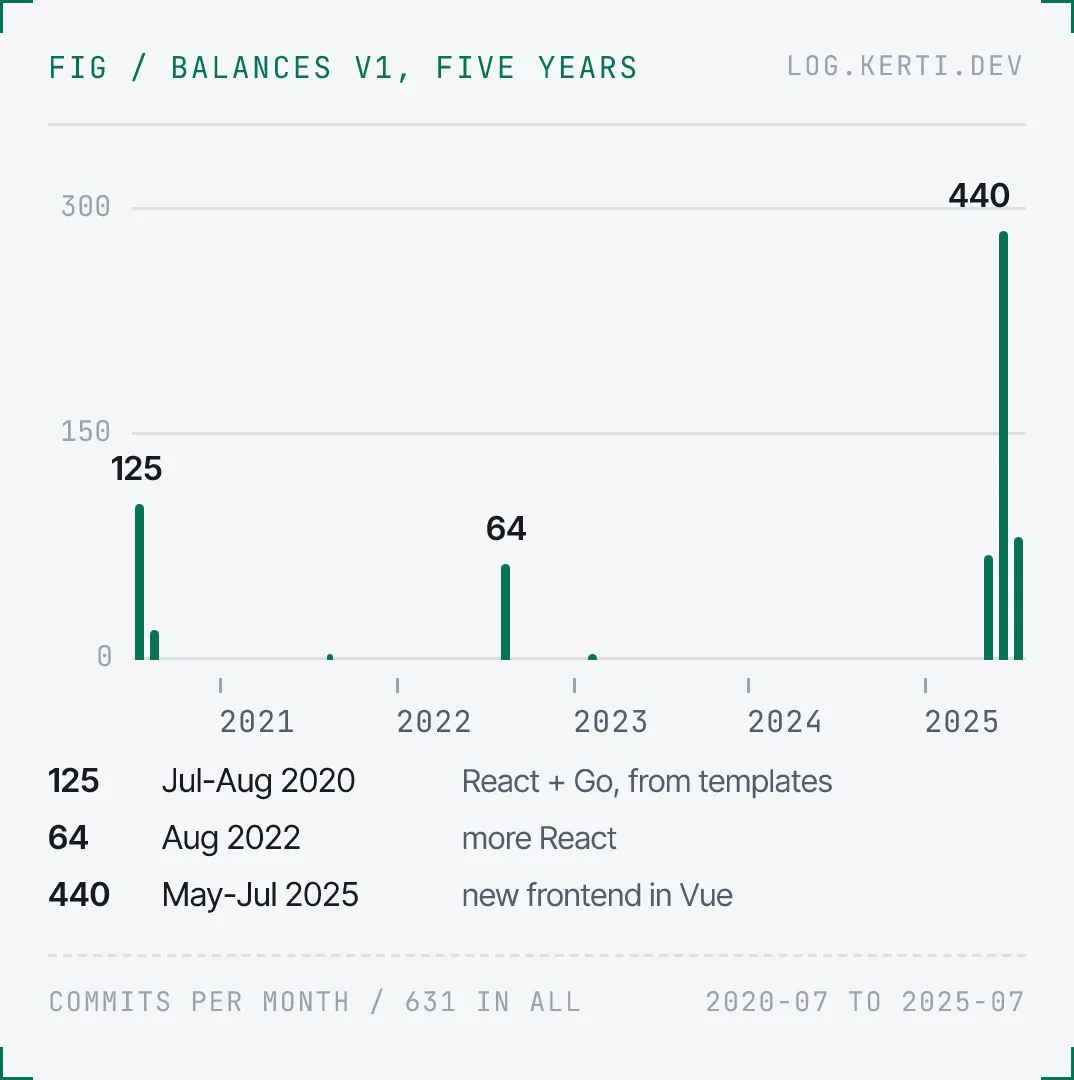
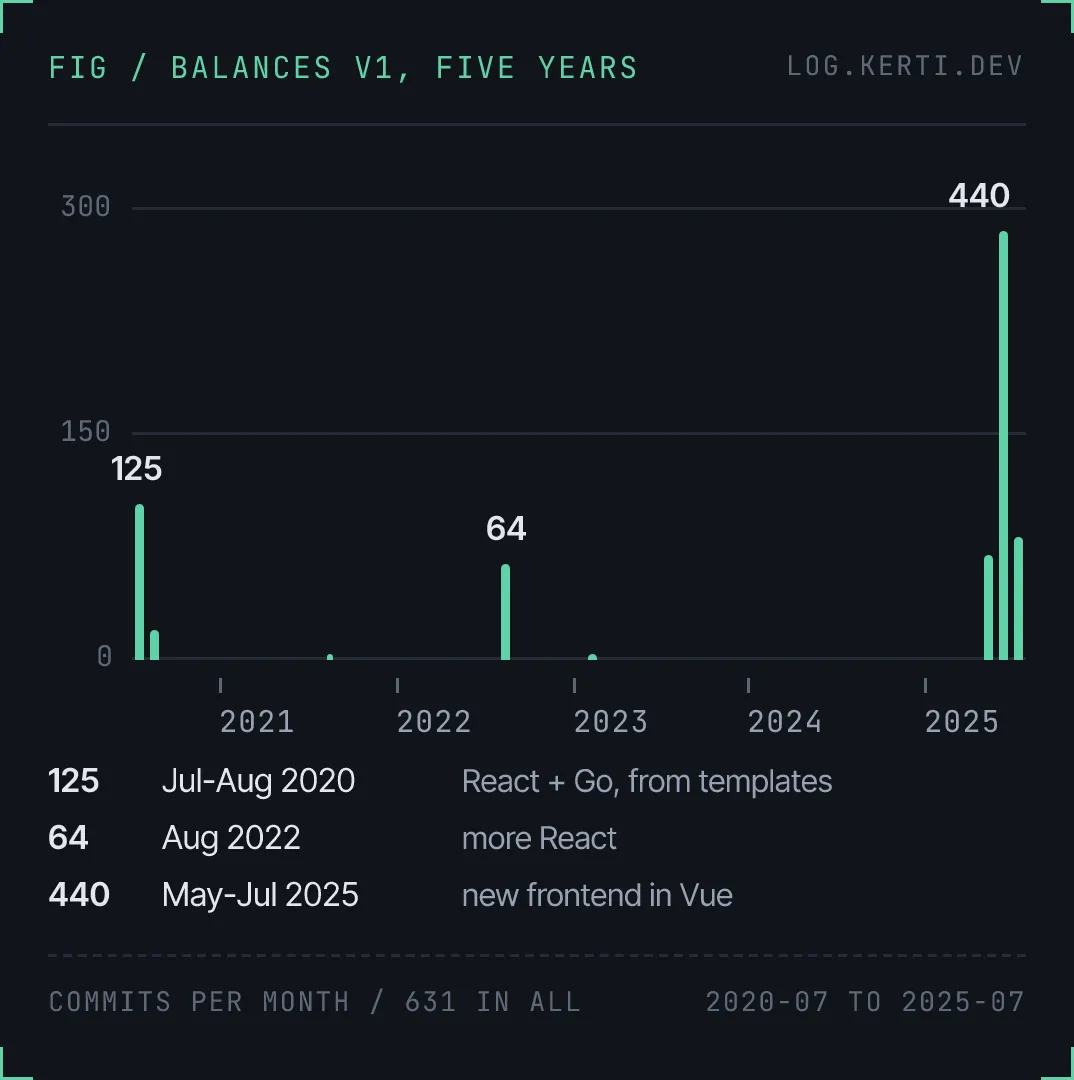
Later on, after my ByteDance role ended in October 2025, I had more time and energy, and the itch was still there. Claude had also reached the point where it was good enough to do the more mechanical things in coding. That’s when I started to build Balances again, from the ground up.
New way of doing things
Looking back, I realized that I was focusing too much on the technology and trying to build something “perfect”. That had to stop. With AI able to take over the build, I shifted my attention to the product itself. I spent a lot of time on how the product solves the problem.
I got Claude to write almost all of the code. My job then was to direct, to push back when Claude hallucinates, to make decisions that the actual user would benefit from (granted, that user is yours truly, at least for now). As an Engineering Manager at ByteDance, I was already doing this at work. Only this time, the job title should be Product Owner.
I had 16 years of engineering experience, and I used it to avoid making a one-shot app. I still make the decisions, even small ones. When everyone else tells the AI to “make no mistakes” (it’s become a meme), I would tell it to make no assumptions. I’m captain in command, Claude is my entire crew.
Learn more
If you’d like to see Balances in action, you can explore it in its current state on the live demo. I’ve also built its landing page at balances.kerti.dev.
Notes
-
Double-entry bookkeeping: The standard way of doing things in accounting. Money leaving an account always enters another account (or accounts, in the case of split transactions). It works, it’s robust, and it’s proven. But I’m a person, not a corporation, so it really doesn’t work for me. ↩
-
Obligasi in Bahasa Indonesia, a term I attempted to translate to English literally as Obligation, which Claude then corrected during the planning phase. Using Surat Berharga Negara in Bahasa Indonesia probably would have been the more accurate term, but it’s way too long for something written on a menu bar. ↩
-
Deposito in Bahasa Indonesia, another term I translated literally into English as Deposit, which Claude advised meant a different thing. ↩
-
No hate for the app itself: The app worked fine for what it’s built for. I just used it in a way that frustrated me. Also, I had an itch to scratch. ↩